

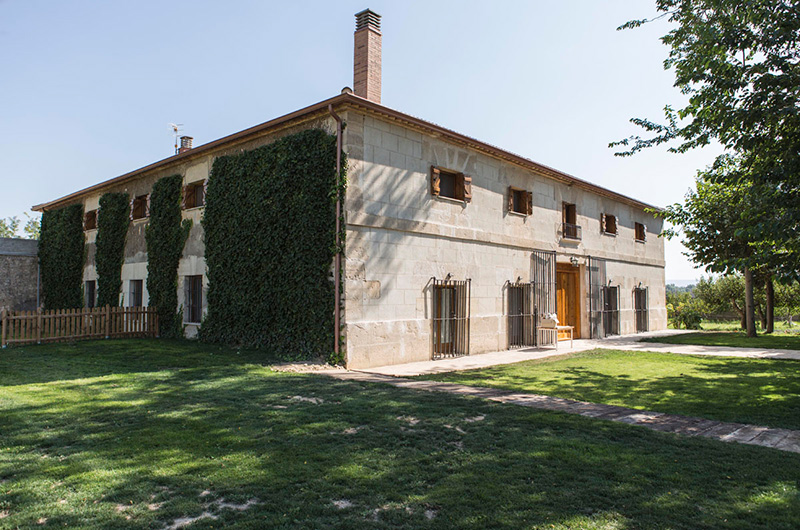
- The main house, known as “Casa de Belver” or “Casa de la marquesa,” along with the surrounding land, is all that remains of what was once the Belver Estate (1474–2026). It was built in the early 19th century (1815) and owes its current name to a beautiful oil mill located next to the house.
- The property currently consists of two living areas: the family area, which has been slightly renovated and features, on the ground floor, 1 kitchen with an old wood-burning stove, 1 dining room, 1 living room with a fireplace, and original wooden stairs. On the first floor, there is an unrenovated bathroom, a long hallway lined with the original wallpaper, and 4 bedrooms. Everything is in a rustic style. The area designated for use as a rural guesthouse has been renovated in a more modern style and features a kitchen-dining room, a living room with a fireplace, six bedrooms that can accommodate 21 people, and private bathrooms in each bedroom. A spacious, open area flooded with natural light connects the two living areas and has traditionally been used as a dressing and makeup area, as well as for yoga workshops when retreats are held at the guesthouse.
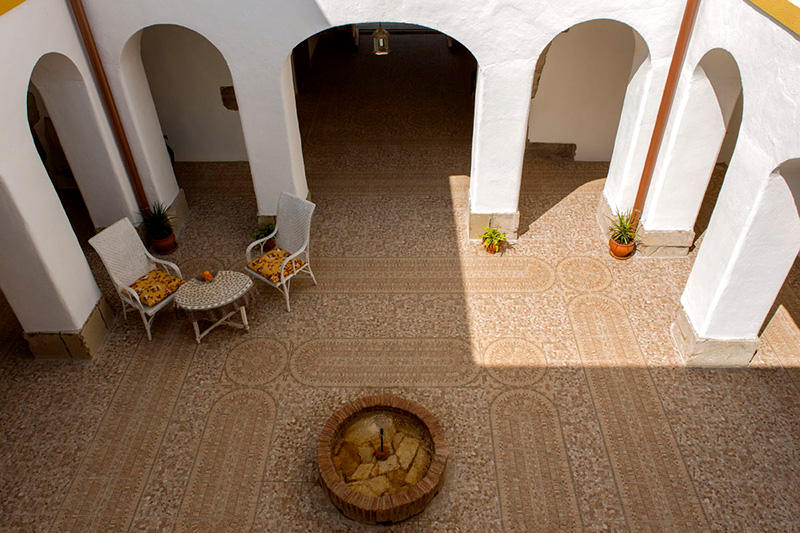
- An Andalusian-style courtyard is the heart of the stately home, blending Roman and Arab heritage. Its design is not only aesthetic but also bioclimatic, conceived to regulate temperature, provide ventilation, and make the most of natural light. The floor is paved with mosaic tiles and features a small fountain in the center, which plays a key role in cooling the space through evaporation.
- It is the oldest and best-preserved olive press in Navarre (1862). In fact, it has been designated a Site of Cultural Interest in the monument category, as it is the only surviving “blood” olive press in Navarre and one of the few in Spain that still features the complete 19th-century technology. This makes the place even more special.
- Surrounding the house is a spacious landscaped lot filled with fruit trees and olive trees, and there is a greenhouse on the property. In front of one of the house’s entrances is a fronton, and in front of the other is a stone well.

Rural House El Trujal de las Bardenas
El Trujal de las Bardenas is a place to discover its beautiful surroundings in Las Bardenas Reales, but also its great historical secret: the oldest and best preserved threshing mill in Navarra (late seventeenth century), declared of Cultural Interest (BIC). The house has been renovated based on a previous geobiological study, following strictly sustainable criteria and using ecological materials. 100% organic vegetable garden located next to the house.
Given the house's characteristics, it is an ideal location both as a film set and for providing lodging and setting up workspaces;